If you run crews, you have had this conversation. Somebody asks for the FLHA and gets sent a JHA. Somebody asks for the JHA and gets handed a field level hazard assessment with the wind speed written at the top. Everybody nods, files it, and moves on.
They are close relatives, but they are not the same document, and the difference is not which country you are standing in. It is when the form gets written. Both are used in Canada and the United States, though JHA is the term more people recognize in the States.
The short version
A JHA (job hazard analysis, sometimes JSA, job safety analysis) breaks a task into steps, names the hazard in each step, and sets the control. It is written once for a task, reviewed periodically, and used to train people on how that task is done safely.
An FLHA (field level hazard assessment) is written at the job, on the day, by the people doing the work. It records what is actually in front of the crew this morning: the weather, the other trades on site, the state of the anchors, the public walking underneath.
One is written at the desk, before the job. The other is written at the job, on the day. One is about the task; the other is about today.
Why the difference matters on site
Most companies working at height need both, and they fail audits for different reasons.
A JHA that has not been looked at in three years describes a task nobody performs that way anymore. An FLHA that is filled in identically every day — same hazards, same controls, same handwriting, twenty days running — tells an inspector that nobody assessed anything; somebody copied yesterday’s.
The useful test: if the sheet could not have been written anywhere else, on any other day, it is doing its job.
What each one usually contains
A job hazard analysis:
- The task, broken into steps in the order they happen
- The hazard in each step
- The control for each hazard, and who is responsible
- Who wrote it, who reviewed it, and when it was last revised
- The training or competency each step assumes
A field level hazard assessment:
- The site, the specific work area, the date and time
- The crew on site and their sign-off
- Conditions today: weather, wind, temperature, light
- Hazards present right now, including the ones created by other trades
- Controls in place, and anything that has to be fixed before work starts
- The supervisor’s sign-off
The other names for the same two documents
The planning document is also called a JSA (job safety analysis), and OSHA’s own guidance uses job hazard analysis. The on-the-day document turns up as an FLRA (field level risk assessment), an FLHRA, a pre-task plan, a THA (task hazard analysis) or a daily safety briefing, depending on the company and on who wrote the client’s contract.
Canadian crews write both, and so do American ones. FLHA is heard more often in Canada and JHA more often in the United States, but neither belongs to one country, and plenty of Canadian companies run JHAs for planned work.
Client language wins. If the contract asks for a JSA, give them a document with JSA at the top, whatever you call it internally.
Do not let the form replace the walk-around
The worst outcome of good paperwork is a crew that fills in the form in the truck and never looks up. A hazard assessment is the record of an inspection, not a substitute for one. The value is in somebody standing at the anchor and looking at what changed since yesterday. The form is how you prove that happened.
That is also the honest answer to “does this make us compliant?” — no document does. Your obligations come from the regulation that applies where you work, and from the competent people on your site. What the documentation does is show what you assessed, what you decided, and who agreed to it. What your province or state requires you to write down is worth reading once, properly.
How RopeDocs handles it
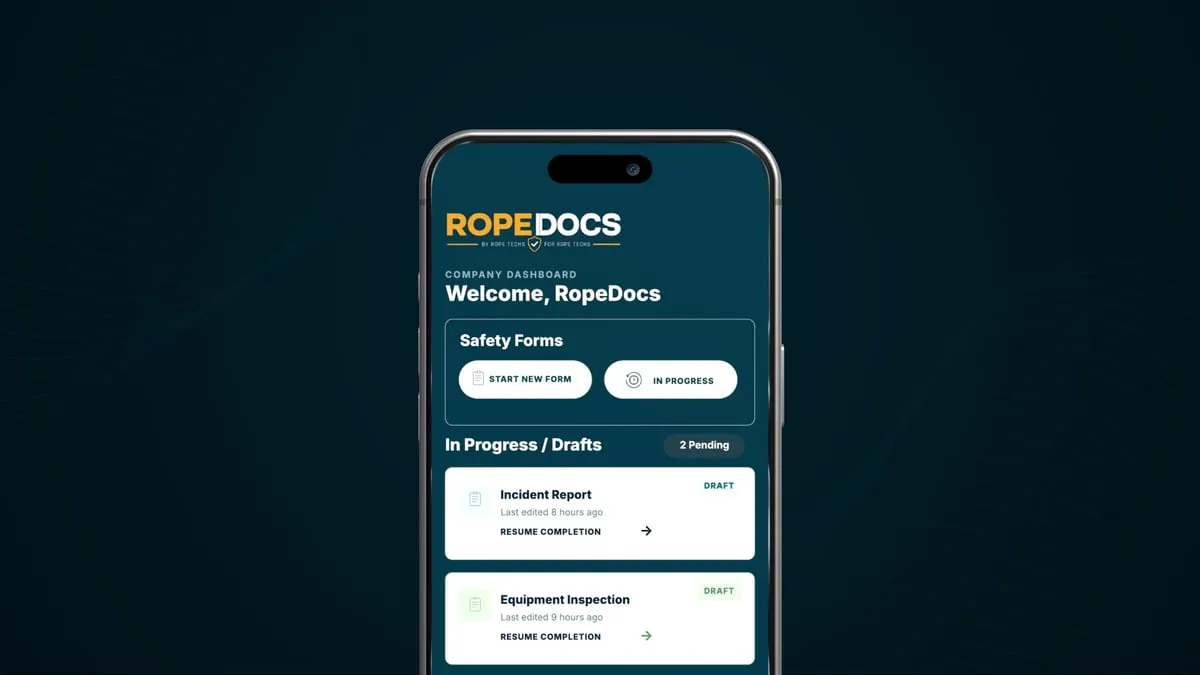
RopeDocs includes both. The JHA is the one you prepare while planning the job; the FLHA is the one the crew completes on site before work starts. You fill in the job details, work through the hazards that are present, review the controls the app suggests for those hazards, add the ones it does not know about, collect the crew’s signatures, and sign off as supervisor.
What comes out is a PDF with your logo on it, dated, signed and specific to that job. If a client, an auditor or your own insurer asks for the assessment from a Tuesday in March, you are looking it up rather than digging through a truck.
Two habits worth building into the crew, whichever acronym you use:
- Write the conditions down before the hazards. It forces a look at the actual site.
- Never pre-fill tomorrow’s. If the form is finished before anyone arrives, it is a form, not an assessment.